


Butyl rubber and EPDM are both synthetic rubbers, but they are designed for different applications. Butyl rubber offers excellent gas impermeability and damping, while EPDM provides better weather, UV, ozone, water, and steam resistance.
| Property | Butyl Rubber | EPDM |
|---|---|---|
| Gas permeability | Excellent | Good |
| Weather resistance | Very good | Excellent |
| UV & ozone | Excellent | Excellent |
| Temperature resistance | Good | Very good |
| Oil resistance | Limited | Poor |
| Rebound | Low | Higher |
| Damping | Excellent | Good |
1. What Is the Difference Between Butyl Rubber and EPDM?
The main difference comes from their polymer structures.
Butyl rubber (IIR) is mainly made from isobutylene with a small amount of isoprene. Its low unsaturation gives it very low gas permeability, good aging resistance, and excellent damping.
EPDM is made from ethylene, propylene, and a diene. Its saturated backbone provides excellent UV, ozone, weather, water, and heat resistance.
In simple terms:
Butyl rubber = gas barrier and damping
EPDM = weather resistance and outdoor durability
2. Butyl Rubber vs EPDM: Key Properties
| Property | Butyl Rubber | EPDM |
|---|---|---|
| Gas permeability | Very low | Higher |
| Airtightness | Excellent | Good |
| UV resistance | Good–very good | Excellent |
| Ozone resistance | Excellent | Excellent |
| Water resistance | Good | Excellent |
| Steam resistance | Good | Excellent |
| Rebound | Low | Higher |
| Damping | Excellent | Good |
| Oil resistance | Limited | Poor |
Actual performance depends on grade, formulation, curing system, and test conditions.
3. Butyl Rubber vs EPDM: Temperature Resistance
EPDM generally has an advantage in high-temperature, hot-water, and steam applications. Butyl rubber also provides good heat resistance, but its service temperature depends strongly on the grade and compound.
When purchasing rubber for high-temperature service, check:
- Continuous operating temperature
- Maximum temperature
- Steam or hot-water resistance
- Aging test results
Do not compare materials based on a single generic temperature value.
4. Butyl Rubber vs EPDM: Oil Resistance
Neither butyl rubber nor EPDM is the first choice for applications involving continuous contact with petroleum oils or fuels.
| Medium | Butyl Rubber | EPDM |
|---|---|---|
| Water | Good | Excellent |
| Steam | Good | Excellent |
| Dilute acids | Good | Excellent |
| Alkalis | Good | Excellent |
| Mineral oil | Limited | Poor |
| Fuels | Limited | Poor |
For oil and fuel seals, NBR or FKM is generally a better option.
5. Butyl Rubber vs EPDM: Weather Resistance
EPDM is generally better for long-term outdoor use because of its excellent resistance to UV radiation, ozone, weathering, and moisture.
Butyl rubber also has good ozone and aging resistance, but EPDM is more commonly selected for:
- Outdoor seals
- Roofing membranes
- Window and door seals
- Automotive weatherstrips
- Outdoor gaskets
For long-term outdoor exposure, EPDM is usually the preferred material.
6. Butyl Rubber vs EPDM: Gas Permeability
Gas permeability is one of the biggest differences between the two materials.
Butyl rubber has very low gas permeability, making it suitable for applications where air or gas retention is important.
Typical applications include:
- Tire inner tubes
- Tire innerliners
- Pharmaceutical closures
- Vacuum seals
- Gas-barrier components
EPDM provides good sealing performance but generally does not match butyl rubber for gas retention.
If airtightness is the main requirement, choose butyl rubber.
7. Butyl Rubber vs EPDM: Applications
| Application | Recommended Material | Main Advantage |
|---|---|---|
| Tire inner tube | Butyl Rubber | Air retention |
| Tire innerliner | Butyl Rubber | Low gas permeability |
| Pharmaceutical stopper | Butyl Rubber | Gas barrier |
| Vacuum seal | Butyl Rubber | Airtightness |
| Roofing membrane | EPDM | Weather resistance |
| Outdoor gasket | EPDM | UV & ozone resistance |
| Hot-water seal | EPDM | Water & heat resistance |
| Steam application | EPDM | Steam resistance |
| Vibration damping | Butyl Rubber | High damping |
| Oil/fuel seal | NBR / FKM | Oil resistance |
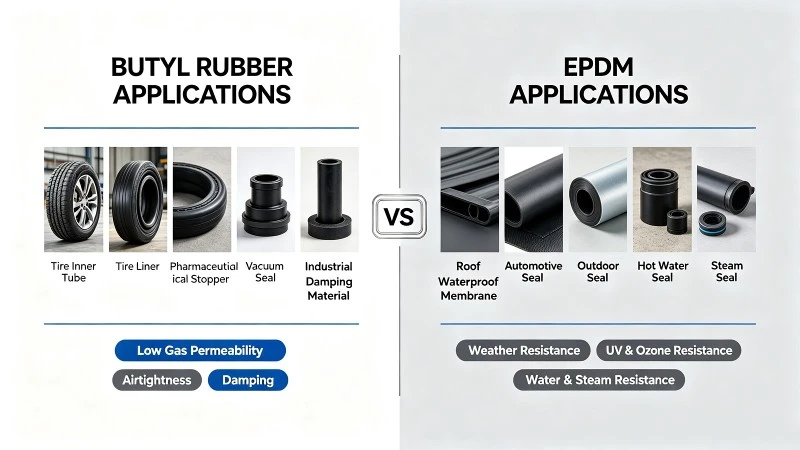
8. Butyl Rubber vs EPDM: Which Should You Choose?
Choose butyl rubber when the application requires low gas permeability, airtightness, or strong damping.
Choose EPDM when the material will be exposed to UV, ozone, outdoor weather, water, or steam.
If neither material fully meets the requirements, CIIR or BIIR (halogenated butyl rubber) can be considered when gas-barrier performance is still important.